The Immune System
We’re familiar with a variety of infectious diseases such as the common cold, influenza, chicken pox, strep throat and, more recently, COVID-19. But what is the origin of these diseases? What causes them, how can they be cured, and how can we reduce our risk of contracting them?
Infectious diseases in humans and other species are caused by numerous different pathogens, usually microorganisms, that are found In our environment. Pathogens include bacteria, protists, fungi and other infectious organisms, as well as viruses, which are not generally considered living organisms due to their inability to replicate themselves independently.
An organism that has been invaded and possibly harmed by a pathogen is called the host. We are constantly exposed to pathogens in food and water, on surfaces, and in the air. Mammalian immune systems evolved for protection from such pathogens; they are composed of an extremely diverse array of specialized cells and soluble molecules that coordinate a rapid and flexible defense system capable of providing protection from a majority of these disease agents. Since most pathogens are invisible, they can also be difficult to avoid and can be transmitted in various ways:
Components of the immune system constantly search the body for signs of pathogens. When pathogens are found, immune factors are mobilized to the site of an infection. The immune factors identify the nature of the pathogen, strengthen the corresponding cells and molecules to combat it efficiently, and then halt the immune response after the infection is cleared to avoid unnecessary host cell damage. The immune system can remember pathogens to which it has been exposed to create a more efficient response upon re-exposure. This memory can last several decades. Features of the immune system, such as pathogen identification, specific response, amplification, retreat, and remembrance are essential for survival against pathogens. The immune response can be classified as either innate or active. The innate immune response is always present and attempts to defend against all pathogens rather than focusing on specific ones. Conversely, the adaptive immune response stores information about past infections and mounts pathogen-specific defenses.
Watch the short video below to get a better idea about how the immune system works.
Disease and Epidemiology
Pathogens are organisms that can cause infectious diseases in humans or other species. We’re familiar with infectious diseases such as the common cold, flu, chicken pox, and strep throat. Since most pathogens are invisible, they can also be difficult to avoid and can be transmitted in various ways:
~ Direct contact with body fluids – HIV, Ebola, mononucleosis, herpes
~ Indirect contact (e.g. germs on a door handle) – rhinovirus
~ Airborne (the pathogen can be inhaled) – influenza, measles, hantavirus
~ Foodborne (must be ingested) – E. coli, salmonella
~ Vector (passed along by a vector host, such as a mosquito) – zika, malaria, bubonic plague
Health conditions can be discovered by identifying how they are distributed in a population in terms of person, place, and time. Once we figure out how the disease is distributed, we can speculate as to why it is distributed in that way. Why did these people get sick, in this place, at this time?
More Definitions
~ Epidemic – a widespread outbreak of an infectious disease where many people are infected at the same time.
~ Epidemiology – the branch of medical science dealing with the incidence, distribution and control of disease in a population.
~ Exposure – the act of coming into contact with a disease-causing microorganism; exposure may or may not lead to infection.
~ Outbreak – the occurrence of a large number of cases of a disease in a short period of time.
~ Pandemic – an epidemic that affects multiple geographic areas at the same time.
~ Vaccine – a substance that contains components from an infectious organism, used to produce active immunity against that organism.
~ Virus – infectious agent that replicates itself only within cells of living hosts.
An epidemiologist studies the health of populations to discover what factors lead to disease. From their research, epidemiologists communicate to the public information about the cause, spread, or threat of certain diseases. An investigation into a potential disease outbreak may follow the steps below:
- Is it an outbreak? Is the disease common to the area or been reported in the area previously? It is considered an outbreak when the number of infections reported is higher than the expected number of infections.
- Identify the specific nature of the disease, by reviewing symptoms and features of the illness. Visit people who became ill to gain a better understanding of the disease and those affected by it. You may be able to gather critical information by asking about their movements and interactions with other people who may also have the disease.
- Determine the number of people infected and the risk factors, by examining the number of people who were exposed, where they were exposed, and over what period of time.
- Create and test a hypothesis based on information on everyone infected along with specimens collected through field work. Diseases can be studied in this way by using cohort studies, which compare groups of people who have been exposed to risk factors with groups of people who have not been exposed. Disease can also be studied using case-control studies, where people with the disease are compared to people without the disease.
- Determine control measures that can target the infection, the agent, the source, or the reservoir, and communicate these findings to local health authorities.
Interpreting Scientific Data
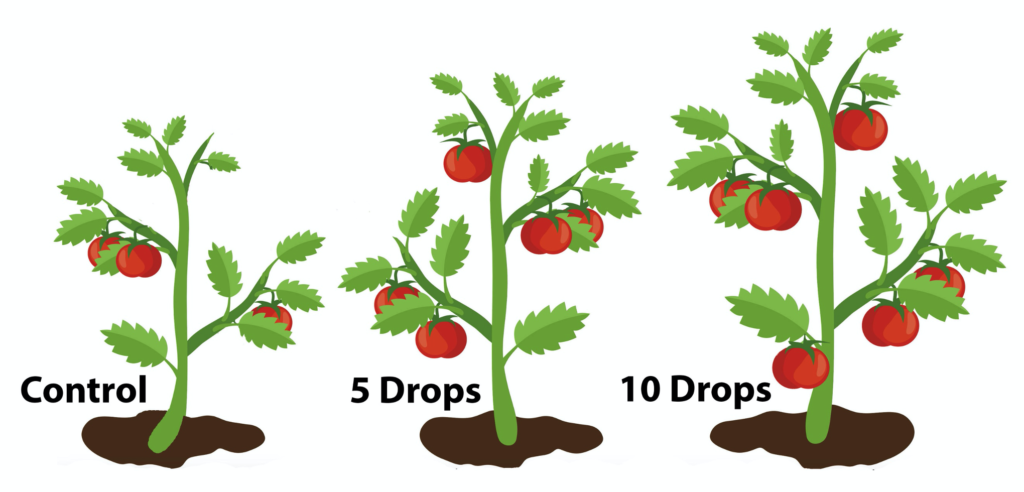
Recall the example we used last week to discuss the scientific method: after growing several plants with different amount of fertilizer, we measured the height and number of tomatoes, to assess whether or not our treatment had any effect.
Let’s say that our results showed that there was a difference between our treatment groups, and plants grown with 10 drops of fertilizer grew taller than both those grown with 5 drops, and those with no fertilizer at all. But how do we know if this result is meaningful? How much taller is “tall enough” to demonstrate that the fertilizer had an effect, and the difference in growth wasn’t due merely to random chance? In order to determine the significance of experimental results, scientists use mathematical statistics.
As an example, let’s look at data we might have gathered after growing our tomato plants.
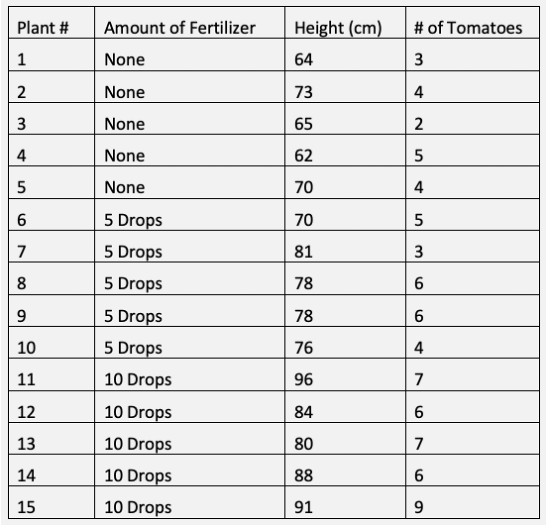
First, it is useful to determine the central tendency of the data – a single value that is most typical, and best describes, the data set. There are various ways of doing this: the mean, the median, and the mode.
- Mean (or average): add all the data points, and divide by the number of points
Example: 3 + 4 + 2 + 5 + 4 = 18/5 = 3.6
- Median: order all data and find the point in the middle.
Example: 2, 3, 4, 4, 5 = 4
- Mode: the number that occurs most frequently
Example: 3, 4, 2, 5, 4 = 4
We will use means for our handwashing data, so you might wish to practice by calculating the means for the tomato data in the table above.
We can also calculate a 95% confidence interval from our data, which is a way of showing us the amount of variation in our data. To put it simply, this is the range of values that has a 95% chance of containing the “true” population mean. A large confidence interval indicates that our sample was extremely variable; a small interval indicates less variation.
In addition, if the confidence interval for one of the sample means overlaps with the other sample mean, the average difference between the two sets of data is not significant. This means that there is a more than 5% chance that the true population means of the two treatments are identical, so any difference we observed could have come about by random chance. Conversely, if there is no overlap between the confidence intervals, there is a 5% or less chance that the true population means are identical. We consider this a significant result, and we can assume that our findings were the result of our experimental treatment (in this case, the amount of fertilizer).
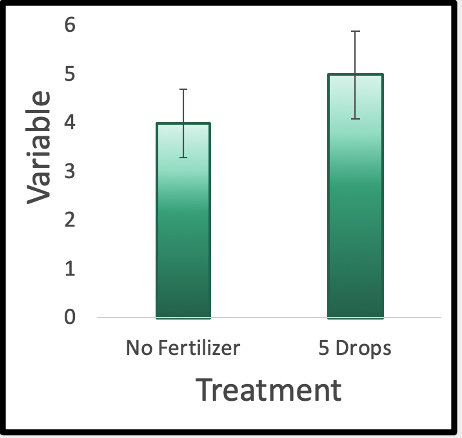
Non-significant result 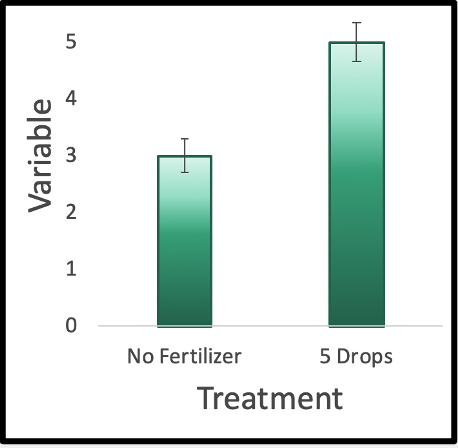
Significant result
To avoid a complicated discussion of statistics, we won’t calculate confidence intervals. Instead, your lab instructor will provide them to you, and we’ll use averages and confidence intervals to create a graph of our data. Graphing can be an excellent way to present experimental results, since a visual representation of data can make it easier to understand.
| Treatment | Height | 95% C.I. for Height | # of Tomatoes | 95% C.I. for # of Tomatoes |
| No Fertilizer | 66.8 | 1.37 | 3.6 | .34 |
| 5 Drops | 76.6 | 1.24 | 4.8 | .39 |
| 10 Drops | 81.8 | 1.86 | 7 | .37 |
When graphed as column charts, the data above would look like this:
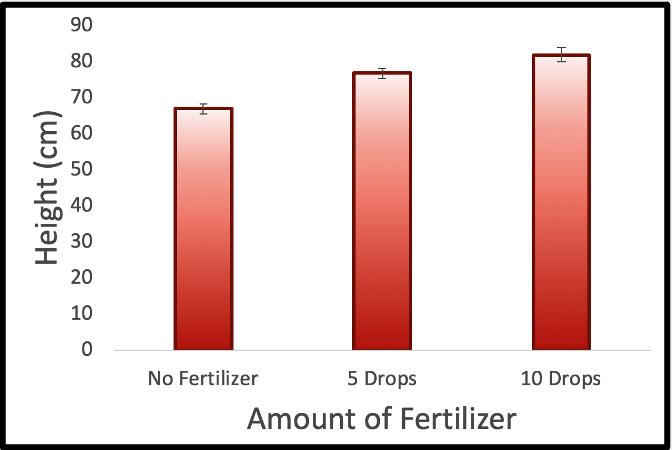
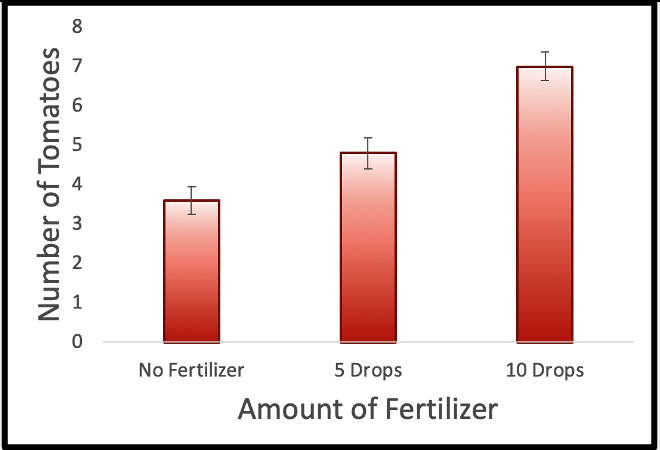
The columns and error bars allow us to quickly see the differences and similarities in our data, as well as how reliable our data are. Today in lab, you can refer back to the example above while evaluating the results of our handwashing experiment.