Introduction
Forensic science involves the analysis of physical evidence to provide scientifically-based information that can be used to argue legal cases. While many people think the word “forensics” is related solely to pathology and autopsies, it is actually a Latin word meaning, “to the forum,” highlighting this connecting with the open court. As such, it plays a vital role in the criminal justice system. During an investigation, evidence is collected at a crime scene or from a person, and analyzed in a crime laboratory so the results can be presented in court. Forensic scientists include people from a wide variety of disciplines, including medical examiners, chemists, accountants, anthropologists, entomologists, mathematicians, dentists, computer analysts, and engineers, to name just a few. Unsurprisingly, principles of biology are regularly used in forensic investigations, for example the analysis of fingerprints and blood samples to determine the identity of an unknown suspect, or the study of insects found on a corpse to determine the time of death.
“Forensis” is a Latin word meaning “to the forum.”
This week in lab, we will explore a number of techniques used by forensic biologists, and attempt to solve a case using evidence found at the “scene of the crime.”
Biometric Identification
Biometrics – measurable anatomical and physiological characteristics – have long been used for identification of an individual. Biometrics can be used by law enforcement not only to authenticate an individual’s identity (to demonstration that you are who are say you are), but more importantly, to figure out who left evidence at a crime scene (a fingerprint left on a murder weapon or a bomb, for example), typically by scanning a database of records for a match.
Many techniques have been used, including DNA sequences, skeletal features, iris patterns in the eye, voice patterns, palm prints, and facial patterns, but today, we are probably most familiar with the use of fingerprints for this purpose. A fingerprint is a unique pattern of friction ridges that forms on the fingers of an embryo during the early weeks of gestation. Because these ridges develop differently for everyone, no two people have exactly the same fingerprint pattern – not even identical twins.
These ridges will leave impressions on most solid surfaces:
- Plastic prints are 3-dimensional prints found on soft surfaces such as wax or soap
- Patent prints are visible prints that are left behind when there is a substance on the fingers such as ink, or paint, or blood
- Latent prints are invisible prints that occur when natural oils present on the skin leave a deposit on a hard surface.
Of these three types, latent prints are the most difficult to locate, but fortunately there are a number of techniques for collecting them. For fingerprints left on a nonporous surface, a powder is distributed on the surface where prints may be located. When the powder adheres to the oils deposited by the finger’s touch, the print becomes visible, and can be photographed, or “lifted” using an adhesive surface, to preserve the evidence. Fingerprints can also be made visible by superglue fuming, which involves heating liquid cyanoacrylate to release gases that will adhere to the fingerprint oils. It is more difficult to retrieve fingerprints from porous surfaces such as fabrics and paper, but there are chemical methods to do this, including a chemical called ninhydrin that reacts with the chemicals present in the fingerprint residue.
After fingerprints have been collected, they must be examined closely by an expert to see if they can be matched with prints taken from a suspect. Friction ridge patterns are grouped into three general types:
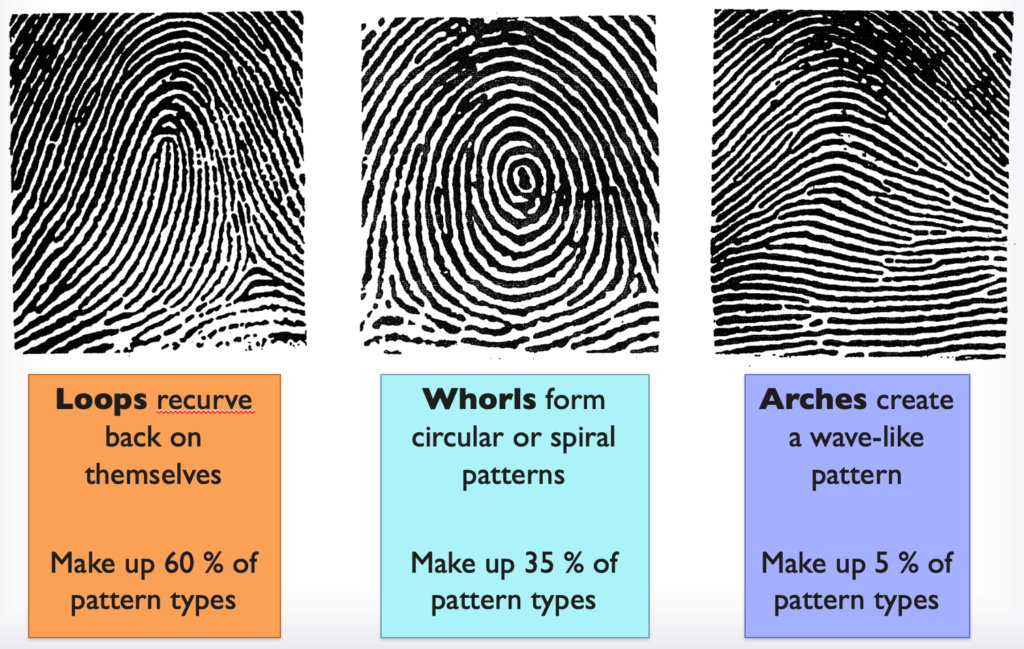
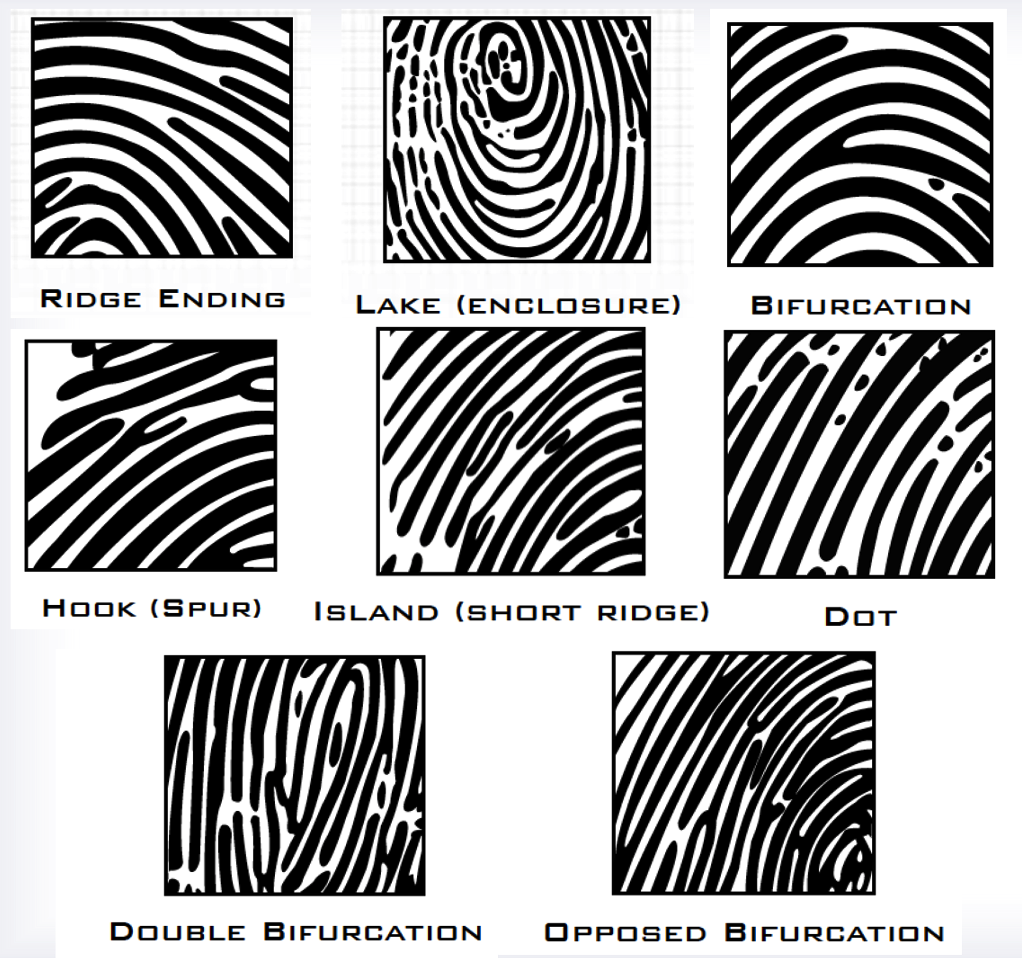
Next, a more detailed analysis involves counting features called “minutiae.” A positive identification generally requires between 8 and 16 matching points with no discrepancies.
Body Fluids Analysis
Many types of bodily fluids may be useful in helping forensic scientists and pathologists put together a detailed picture of how an individual died. They may also present means of identifying a perpetrator.
Bodily fluids are broken down into two categories:
- Excreted, including sweat, breast milk, earwax, bile, vomit, feces, and sebum (skin oil)
- Secreted, including pre-ejaculatory fluid), blood or plasma, semen, saliva, vaginal fluids, and urine
The most common body fluid of interest encountered at crime scenes is blood. Although perhaps less common, saliva may also be encountered during a criminal investigation and urine may be encountered in cases of abuse or sexual assault, for instance. The presence of semen and/or vaginal secretions are of particular importance during the investigation of sexual assaults. These fluids are contained within the human body, and those that are classed as being secreted can be found on or about the body of an individual who has been the victim of a crime.
It is the job of the forensic scientist to establish if any of these bodily fluids are present at a crime scene and take the necessary steps to ensure that they are collected. The use of chemicals and alternative light sources (ALS) can also be deployed to find fluids in places where they might be overlooked, including darkly lit crime scenes, or large outdoor areas. . In addition to bodily fluids the forensic scientist will look for trace evidence such as skin particles, hairs, fingernails and anything else that might have been in contact with an attacker or assailant.
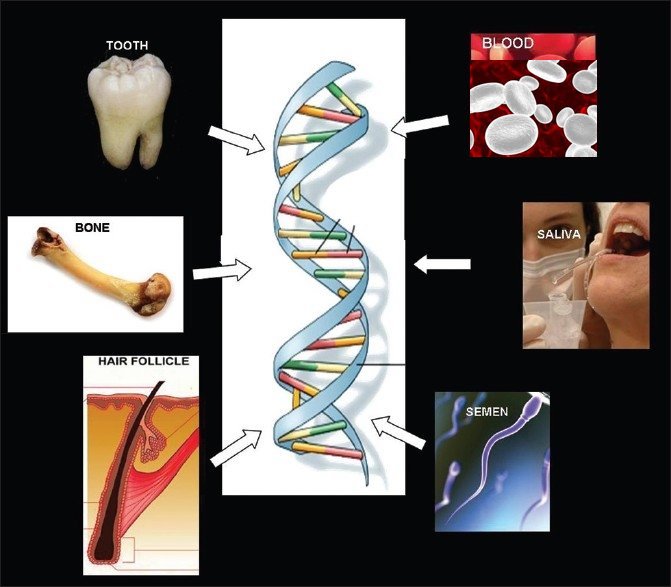
Some bodily fluids contain sufficient information to gain a DNA comparison, which can be crucial in identifying victims and suspects. The DNA molecule is the molecule of heredity that is passed from parents to offspring. DNA can be used as a molecular identification tag when subjected to the process of DNA fingerprinting. This is based on the fact that different people will always have different DNA sequences, unless they are identical twins. Scientists can compare sequences in the human genome that vary from person to person, for example repeated DNA sequences known as short tandem repeats (STRs). Each person has two alleles at each STR site, and there are dozens of forms (alleles of different lengths) of these repeating segments. The chance of two people randomly having the same two alleles is very small, and can be used to make identification of victims or suspects.
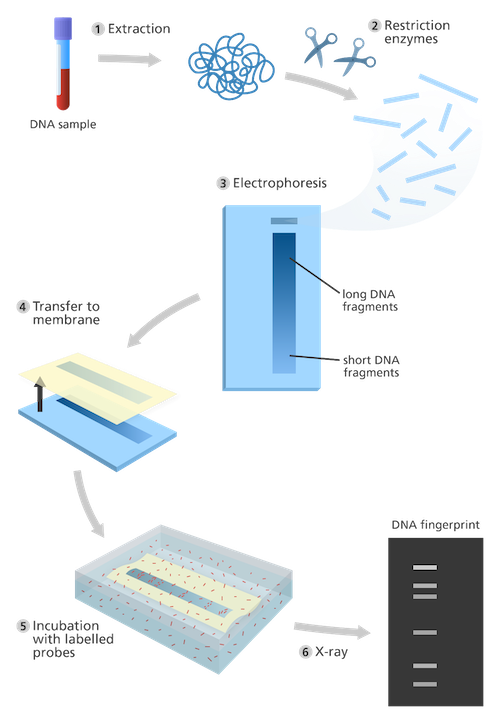
STRs are evaluated by a process called gel electrophoresis, in which they are sorted by electrical charge and size Samples are loaded into a gel, with unknown DNA next to samples from known individuals. Then, an electrical current is applied. Since DNA has slight negative charge, fragments are pulled toward positive end of gel. Smaller alleles with fewer repeats move quickly; larger alleles move slowly. DNA fragments of the same size show up as bands on the gel. This creates a pattern by size, so scientists can look for match in patterns to identify sample. In addition to crime scene samples, this technique is also used for other purposes, such as paternity testing.
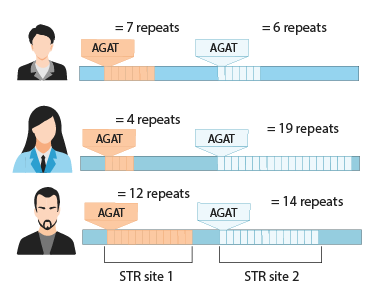
To create a forensic DNA profile, more than one site is compared – generally, between 13 and 16 different STR sites. When multiple sites are compared in this way, the probability of matching someone who did not provide the blood sample is more than 1 out of 100 billion.
Not all biological evidence can be tested for DNA. In order for bodily evidence to contain DNA, it must have nucleated cells.
- DNA can be obtained from:
- White blood cells
- Semen
- Saliva
- Body tissues
- Bones and teeth
- Hair follicles
- DNA cannot be obtained from:
- Strands of hair
- Red blood cells
- Urine (although some people may excrete cells that contain DNA)
Body fluids can also be tested for chemical substances, such as drugs, by the use of mass spectrometry. A machine called a GC/MS (gas chromatography mass spectrometer) is calibrated to recognize the molecular signatures of known compounds. Each compound creates a characteristic peak when found in a tested sample. Fluids found at crime scenes, or taken from victims or suspects, may be tested in this way to determine what substances may be found in their systems.
Adapted from http://exploreforensics.co.uk/
Determining the Post Mortem Interval
There are 4 stages or changes that occur in the body after death. These are used as indicators to determine the cause, time, etc., especially in forensic pathology. We’ve often heard some of these terms used in movies, such as lividity, rigor mortis, etc. Most of us must also be familiar with these signs, even though we might not know the technical terms for them.
Once death occurs in a body, it undergoes a series of changes that occur in a timely and orderly manner. These stages are also affected by the extrinsic and intrinsic factors of the corpse. Determining the stage and state of decomposition of the body, the pathologist can estimate a time frame in which death occurred. Since there is no fixed duration for these stages, it is impossible to determine the exact time of death unless there is a witness or another verifiable source of this information.
The time difference between the time of death and the examination of the body is known as the Post Mortem Interval (PMI). The longer the PMI, the larger the time of death window will become, i.e., harder to determine the time of death. There are 4 stages: Pallor Mortis, Algor Mortis, Rigor Mortis and Livor Mortis.
Pallor Mortis: The first change that occurs in a corpse is the paleness in the face and other parts, which occurs within 15 to 30 minutes of death. This is due to the cessation of the capillary circulation. It is usually insignificant in terms of determining the time of death, unless of course, death has occurred shortly before the finding of the body.
Algor Mortis: Humans are endothermic organisms, which means that we can control and maintain our inside temperature, regardless of the outside environment. This property ceases to function after death, so a corpse will eventually start cooling or heating to match the external temperature. Our bodies are usually warmer than the outside temperature, and thus the bodies cool. However, if the body is in a warmer environment, it would heat up. The rate at which the temperature of the body is acclimatizing to the outside environment gives some indication of the PMI. However, it can be affected by a number of factors, such as fluctuations in outside temperature, the thickness of clothing on the corpse, the place where the corpse has been found, any drugs or other intrinsic factors that could affect this temperature adjustment, etc. Therefore, it cannot be used alone to determine the time of death.
Rigor Mortis: After death, a corpse will first go flaccid (all the muscles will become weak). After this, the whole body will stiffen, when the muscles contract and stay in that position. This stiffening of the body is known as rigor mortis. Based on the position of the body in rigor, certain other deductions can be made, such as whether the site where the body was found is the site of death, if the person died in a particular position etc. The process of rigor mortis starts within 2 hours of the occurrence of death and is usually completed by around 8 hours. Although there is no fixed time as to how long the body would stay in that position, studies suggest a range from 18 hours to 2 days. This is also affected by the ambient temperature, the rate of decomposition of the body etc. Rigor mortis ends due to the decomposition of the muscles and body. Hence it is highly dependent on the outside and inside environment.
Livor Mortis: This is the final stage of death. When the heart stops beating, the location of blood is now dependent on gravity, and tends to collect based on the position of the body. If the person was flat on their back when they died, the blood would collect in the parts that are touching the base. If the person was hanging, it would collect in their fingertips, toes, and earlobes. Initially, when the skin is pressed, the skin would turn white and return to the bluish color upon the removal of the pressure. After approximately 12 hours, however, the blood gets “fixed” there and the skin wouldn’t turn white. The bluish coloring of the skin is called livor mortis or lividity. Lividity can give insight into the time of death. It can also help investigators determine if the body has been moved from another place.
All these stages of death are often overlapping in their occurrence. They may start separately, but most of them continue to occur simultaneously. However, other factors are also taken into consideration during investigations. This is mainly because there are factors that can affect these stages considerable. Hence, investigators never rely only on one or 2 factors, but rather take a number of them into consideration and then draw their conclusions.
Determining Time of Death with Entomology
When an animal dies, flies are among the first to find and colonize the carcass, usually arriving within 10 minutes of death. Adult females often search out the natural body openings to lay their eggs, which means that eggs and larvae begin feeding in the head region first (mouth, nostrils, eyes, ears), followed by the excretory and reproductive openings. Any injuries associated with death (gun shots or puncture wounds) can also provide openings to the body. The trunk of the body is invaded much later in the process.
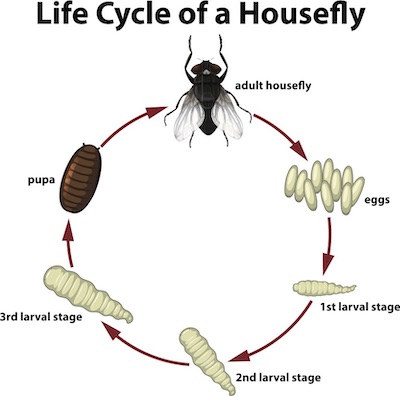
The ordered development of flies and other insects on a dead animal is predictable, allowing us to use them to help determine the time of death.
The four development stages through which flies and many other insects pass is called complete metamorphosis. Here, the insect hatches from an egg into a white grub, called a larva or a maggot, which crawls like a caterpillar and actively consumes food to grow quickly. The insect will pass through several instars or stages during this process. Every time it completes a stage, it must shed a tough or hard exoskeleton and thus molt. Upon reaching larval maturity, the maggot will darken and turn into an immobile pupa. The pupa may look inactive, but many changes are occurring inside the casing. Soon, a winged adult fly emerges. The adults will then mate, and the females will lay more eggs.
The rate of insect development is influenced by temperature because insects are ectothermic, which means their body temperatures are largely dictated by the outside temperature. Only when the outside temperature warms an insect’s internal body temperature to its critical level can the insect become active (and eat and grow) Sometimes investigators may find large maggots on relatively young corpses and small maggots on relatively old corpses, which is the opposite of what would usually be expected. However, if enough information is known regarding the temperature of the microclimate in which insects occur, the insect community associated with a corpse may be investigated by forensic entomologists to estimate the postmortem interval—the time between death and discovery of the corpse.