Phylum Cnidaria
About 10,000 species of Cnidaria exist. All are aquatic and most are marine. These include the jellies, corals, hydroids and sea anemones. Cnidarians have two forms. Both show radial symmetry: the polyp (sessile) and the medusa (free-living). Cnidarians reproduce both sexually and asexually, and individuals of some species spend part of their lives as a polyp and part as a medusa. The sexual stages usually are dioecious (with female and male individuals). Most cnidarians are predators that feed on zooplankton, but a few eat larger organisms, including fish, mussels and urchins. They obtain prey using their cnidae, organelles unique to the phylum, that can harpoon, spear and paralyze their prey, or simply function like a ‘Velcro’ sticky trap (see lecture notes). We will introduce the four cnidarian classes, and investigate two of them more closely.
The classes differ in structure and in the relative dominance of the polyp versus medusa stage.
Characteristics:
- Radial symmetry
- Tissue level of organization
- Two germ layers (diploblastic -‐ endoderm and ectoderm)
- A middle layer of jelly-like mesoglea
- Gastrovascular cavity originating from the blastocoel
- Single opening for mouth and anus that is surrounded by tentacles
- Cnidocytes present for prey capture
- Sessile or free-‐floating
- Sexual and asexual reproduction
- Two main body forms
- Polyp: sessile hydroid form
- Medusa: floating jelly form
CLASS HYDROZOA-: both polyp and medusa present with polyp stage dominant, solitary or colonial, smaller medusae than Scyphozoa, polyps asexual, medusae sexual, freshwater or marine.

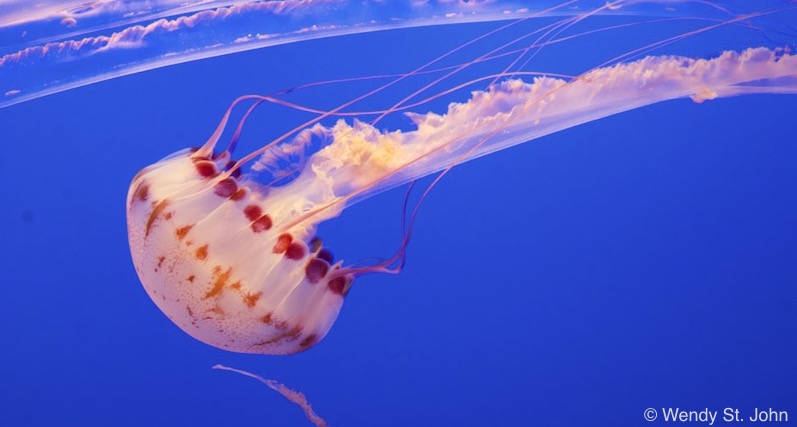
CLASS SCYPHOZOA: polyp stage reduced or absent; medusa stage dominant, polyps asexual, medusae sexual, medusae bell-shaped, marine.
CLASS ANTHOZOA: solitary or colonial, only polyps (sexual or asexual) in life cycle, no medusae, digestive cavity of polyp subdivided by septa, marine.

CLASS CUBOZOA: solitary, medusa stage only, cube body shape, 4 sets of tentacles, well developed eyes, highly venomous, about 20 species, marine.

Class Scyphozoa


Watch the video below through timestamp 6:17. The video features the dissection of a moon jelly, and a sea anemone.
- What is a tissue?
- What are the two body forms of Cnidarians?
- What is the common name of Aurelia aurita?
- What is the meaning of tetramerous (if you missed it during the video, look up the word in the Root Words list we worked with last week).
- What body form does the “typical” jellyfish exhibit?
- Pause the video, and sketch the specimen. Label the following structures:
- Bell
- Margin
- Tentacles
- Oral arms
- Mouth
- Gastric pouches
- Gonads
- Where does digestion take place?
- What structures allow the jellyfish to sting prey?
Class Anthozoa
Several species of anemone are local to the waters along the coast of California. These include aggregating anemones (Anthopleura elegantissima), the giant green anemone (Anthopleura xanthogrammica), or the giant plumose anemone (Metridium farcimen). The giant green is a solitary anemone that tends to get quite large. The aggregating anemone reproduces asexually by fission and forms large clonal groups of smaller individuals. Both can be found on California’s rocky shores. Metridium lives subtidally and can be found on the sides of local docks.
In the class Anthozoa, there is no medusa stage. These organisms may be either solitary or colonial. If you take a cross section from these animals, you will see that their gastrovascular cavity is divided into several sections with structures called septa. Resume the video above from timestamp 6:18, and answer the following questions.
- What is the body form of the specimen we are examining?
- What are the three main regions? present
- How does this animal adhere to a substrate?
- Describe the tentacles. What is their primary purpose?
- Where does fertilization take place?