The phylum Mollusca is the second most diverse phylum (after the arthropods) with 50,000 – 100,000 species including snails, slugs, clams, octopus and squid. Molluscs possess a coelom or fluid-‐ filled cavity between the body and the visceral organs. The molluscan coelom is relatively reduced, surrounding only the area around the heart. The sinuses of the open circulatory system of the majority of molluscs also serve as a hydrostatic skeleton used in locomotion by some species (especially burrowing bivalves). Others make use of the mantle (squid & octopus) for ‘jet propulsion’ or a muscular foot to generate pedal waves.
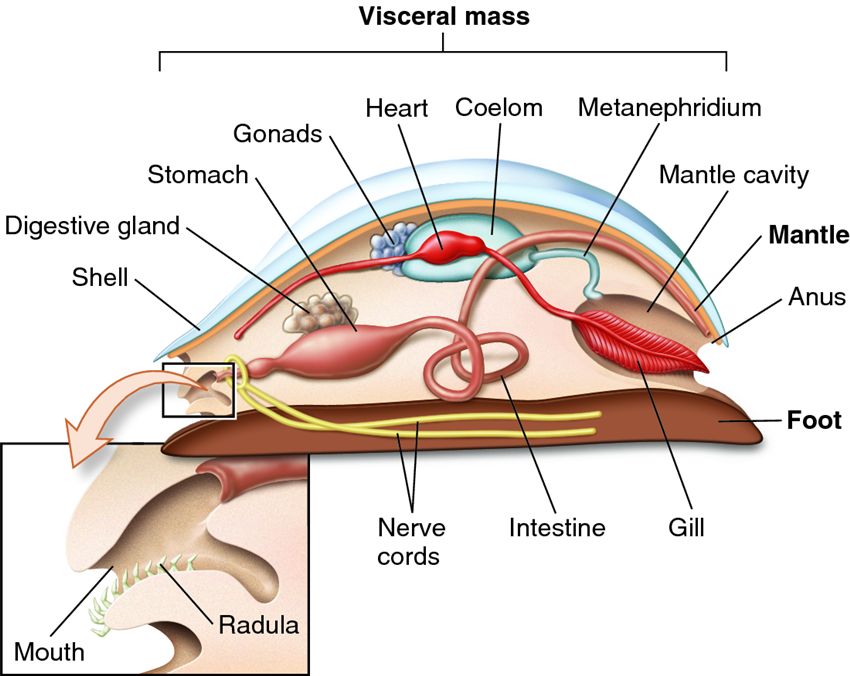
Another important characteristic of molluscs is the presence of a complete gut with a mouth at one end and an anus at the other. The one-‐way flow of material through the gut allows for regional specialization of the digestive tract. As the food moves along in one direction, certain portions of the digestive tract function in storage, mechanical grinding, and absorption. The unidirectional gut also allows the organism to keep eating while digesting and defecating. This more efficient mode of digestion is important, especially for large, very motile animals that require more energy. Animals that possess a complete gut also possess some type of circulatory system: when one region of the gut is specialized for nutrient absorption, the nutrients must be actively distributed to the rest of the body. As body size increases, simple diffusion is insufficient to deliver and remove respiratory gases, and a means of active respiration to transport oxygen to those tissues not in direct contact with oxygen becomes more important (i.e., a circulatory system).
PHYLUM MOLLUSCA
- Coelomate
- Bilateral symmetry
- Protostome development
- Body with three parts, including a muscular foot, a visceral mass, which contains the internal organs, and a mantle: a fold of tissue that generally secretes a shell
- Many possess a radula, a uniquely molluscan feature to scrape food
- Most molluscs pass through a trochophore larval stage, but there are additional larval forms also found in this phylum.
- Cilia are often present and are used in feeding & locomotion.
- Metanephridia are present in most species and function in osmoregulation and excretion.
- Molluscs are mostly dioecious (have separate males and females) and have an incredible diversity of body forms, habitats, and feeding habits.
- Seven major classes. We will examine four of these classes today:

CLASS GASTROPODA: snails, limpets, and slugs. Gastropods are a very diverse (>40,000 spp.) taxon. Generally well-‐developed head with eyes and tentacles; broad, creeping foot; coiled or cone-‐shaped shell, or no shell; body mass undergoes torsion during development. Gastropods can be marine, aquatic, or terrestrial.

CLASS BIVALVIA: clams, mussels, oysters, scallops. Two shell valves, right and left, secreted by large two-‐lobed mantle; Narrow foot used for burrowing; Head reduced or absent; No radula; Sense organs in mantle.

CLASS CEPHALOPODA: squid, octopus, nautilus, cuttlefish. Large well-‐developed head and nervous system with complex eyes and tentacles around the mouth derived from the foot; shell small or absent; active predators.
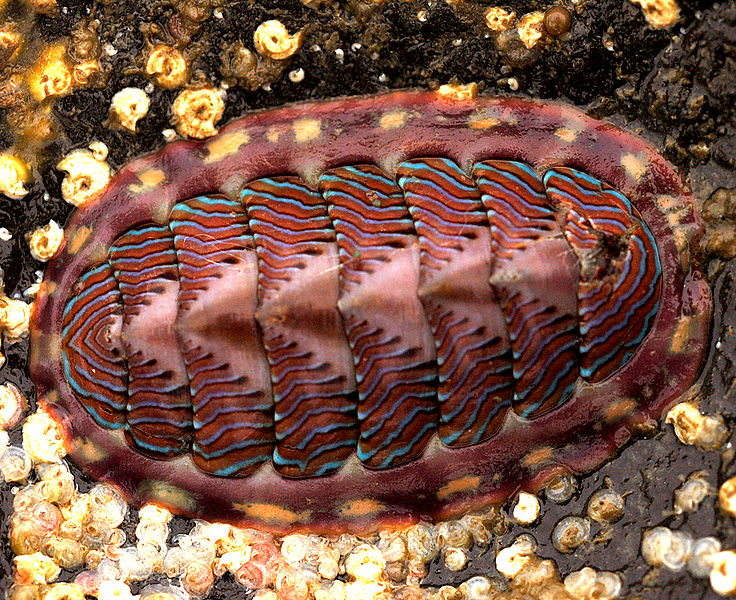
CLASS POLYPLACOPHORA: Marine animals (chitons) with oval body form and reduced head; Armor of 8 valve-‐shells over dorsal surface; radula present; Basic body plan of chiton probably represents the modern version of the “ancestral” Molluscan body plan.
View the video below. As you watch, fill out the two charts – internal anatomy, and external anatomy – as completely as you can.


After you finish viewing the first video, for fun, take a look at this one:
- What are the main differences you notice between the specimens in the two videos?
- What things about them are the same?