NOTE: Incorporate material from this page into the lab in 2023: https://wendystjohn.summerlark.net/2021/02/22/131-nematodes/
Student landing page: https://wendystjohn.summerlark.net/2021/02/21/131-w6-lab-ecdysozoa/
Student worksheet:
NEMATODES
I have asked for some live specimens, but I’m not sure what Kandis will be able to procure. So, all they need to do is observe whatever they can about the live specimens, and do a quick sketch. There is also a nematode video embedded in the powerpoint that you can share with them (although it’s not the most engaging video in the world – if you know of a more exciting one, let me know).
- Look at the nematode species on display. What differences can you see between them? Make a quick sketch of one live specimen below, and label the head and any other structures you can identify.
TARDIGRADES
First, show them this video:
I have requested a culture of tardigrades, but I don’t know if this is possible. If so, they will be able to look at them under the microscope. If not, they can answer the question from watching the video.
- Why do you think their common name was given to them?
CRUSTACEA FEEDING STRATEGIES
There are several species of live crustaceans on display in the lab, and we are asking the students to observe them, particularly any feeding behavior they witness. You can also screen the videos linked below for them, to supplement what. they will see in lab. View the videos of several different crustaceans.
- Compare the feeding and walking appendages found on each specimen. What are the major differences between them?
- Answers will vary – they just need to describe their observations
- Record the name of each species that is shown and describe the differences among them either in words or with quick sketches.
- Answers will vary depending on what Kandis has provided
CRAYFISH ANATOMY
There are preserved crayfish specimens in lab for them to examine. First, show them the video below that walks them through the external anatomy. There aren’t enough crayfish for all groups to be looking at one at the same time, so you may wish to have the video available to show individual groups a few at a time. They are being asked to draw a dorsal view of their specimen and label some structures. There is a diagram of the ventral view of the animal, which they just need to label.
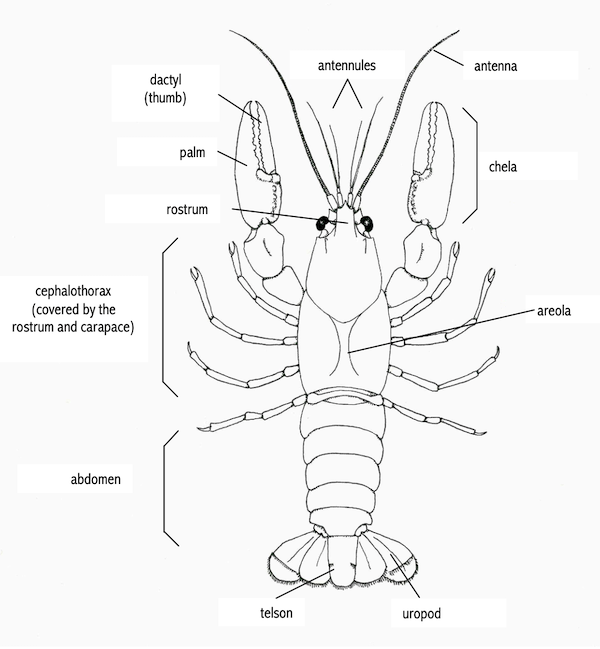


- How many segments and appendages are there in the cephalothorax?
- How many abdominal segments are there?
- How many abdominal appendages are there?
- In most male malacostracans, the anterior two pleopods are modified into copulatory organs. They are enlarged and point in a forward direction between the last walking legs (which are attached to the cephalothorax). What are the differences between these two segments and the posterior pleopods.
This is a good guide to the anatomy: https://jb004.k12.sd.us/my%20website%20info/BIOLOGY%202/ANIMAL%20KINGDOM/CRAYFISH%20DISSECTION/CF%20DISSECTION.htm
CHELICERATES
Chelicerata
Examination of Merostomata (a marine chelicerate)
Examine the dried horseshoe crab specimens closely as well. Note the compound eyes, the carapace, the pedipalps and number of legs on the ventral side, and the presence of the book gills, which are legs that have been modified into respiratory structures.
- Based on its physical features, to what group of invertebrates do you suspect the horseshoe crab is the most closely related?
- They will probably say crabs
- Now, if I were to tell you that they lack antennae, and that they have specialized sensory structures called pedipalps, which group do you think might be their closest relatives?
- They are more closely related to spiders
Examination of arachnids (terrestrial chelicerates)
Some features of terrestrial arachnids clearly represent homologies with those of their marine chelicerate relatives. For example, they have book lungs, which are modifications of the book gills that horseshoe crabs use to respire.
- What is the difference between a gill and a lung?
- The main difference between gills and lungs is that gills are the type of respiratory organs specialized to breathe in water, whereas lungs are the type of respiratory organs specialized to breathe in the air. Gills are made up of rows of filaments through which water continuously flows while lungs contain sacs connected to the outside through a network of breathing tubes.
- Which arachnids have larger pedipalps, spiders or scorpions?
- Scorpions
- What are the differences you can see in the cephalothorax and abdomen between spiders and scorpions?
- Answers will vary based on their observations
Show them the video below. They will also be able to view Rosie, our tarantula, on display in the classroom.
- What type of spider is shown in the video?
- Orb weaver
- What type of spider is on display in the classroom?
- Tarantula
- Describe similarities and differences
- Answers will vary
- Do spiders bite? Or don’t they??
- This is discussed in the video
MYRIAPODA
Class Chilopoda. The centipedes. Flattened body with one pair of walking legs per segment. Appendages on first trunk segment modified from legs into poisonous fangs.
Class Diplopoda. The millipedes. Two pair of walking legs per diplosegment (pairs of segments that appear to have fused), body often cylindrical.
- View the specimen(s) on display. Describe the similarities and differences between them.
- Answers will vary
HEXAPODA
- What adaptation in particular lead to the great success of insects?
- Flight
Show them this short video (make sure to turn on the closed captions)
- Which group of insects is most diverse?
- Coleoptera
- Which of the orthopterans on display best represents some form of crypsis?
- Walking stick/stick insect
- Compare and contrast a dragonfly to a damselfly. List features that are the same and features that are different in the space below. Pay attention to the arrangement of its wings, body form, and emorphology.
- Answers will vary based on their observations
- Examination of butterfly wings-‐ Look at a butterfly’s wing under the dissecting microscope. Describe what you see, including the pattern, colors, and the structures that make up the pattern.
- Answers will vary. One thing I am hoping they will recognize is that the wings are covered with scales. You can also explain that many of the colors we see are caused by light refraction, rather than pigmentation
Look at the “Butterflies of California.”
- List three species that appear to exhibit aposematic coloration
- Answers will vary
- What are bright colors often a warning against?
- Poison, venom, toxins
- List two species that seem to exhibit cryptic coloration
- Answers may vary
- List three prey species (ones that could be garden pests)
- They will get these answers from the handout in their worksheet
- List three predators (beneficial “bugs” that could help reduce pests in the garden without the use of insecticides
- They will get these answers from the handout in their worksheet